Quick answer
Stop on firm level ground, apply the handbrake, loosen wheel nuts before jacking, lift at the correct point, fit the spare, tighten in a star pattern, then lower and check pressure.
Safely change a flat tyre at the roadside by securing the car, loosening nuts before jacking, and fitting the spare correctly.
What you’ll need
- Tool: Wheel brace or tyre iron
- Tool: Car jack
- Tool: Warning triangle
Materials
- Material: Spare wheel or tyre repair kit
- Material: Wheel chock or sturdy block
Step by step
- 1
Stop safely on firm, level ground and secure the car
Pull over as far off the road as possible onto firm, level ground. Switch on the hazard lights, apply the handbrake fully and engage first gear or park. Turn the engine off. If you have a wheel chock, place it against the wheel diagonally opposite the flat.
- 2
Get passengers clear and place a warning triangle
Ask all passengers to leave the vehicle and stand behind a safety barrier if one is present. Place a warning triangle on the road at least forty-five metres behind the car on a normal road, or further back on faster roads, to alert approaching traffic.
- 3
Loosen the wheel nuts before jacking
Use the wheel brace to loosen each wheel nut by half a turn while the tyre is still on the ground. Turn anticlockwise. Do not remove them yet. The weight of the car prevents the wheel from spinning, making this much easier and safer than trying to loosen nuts while the wheel is in the air.
- 4
Jack the car at the manufacturer's designated point
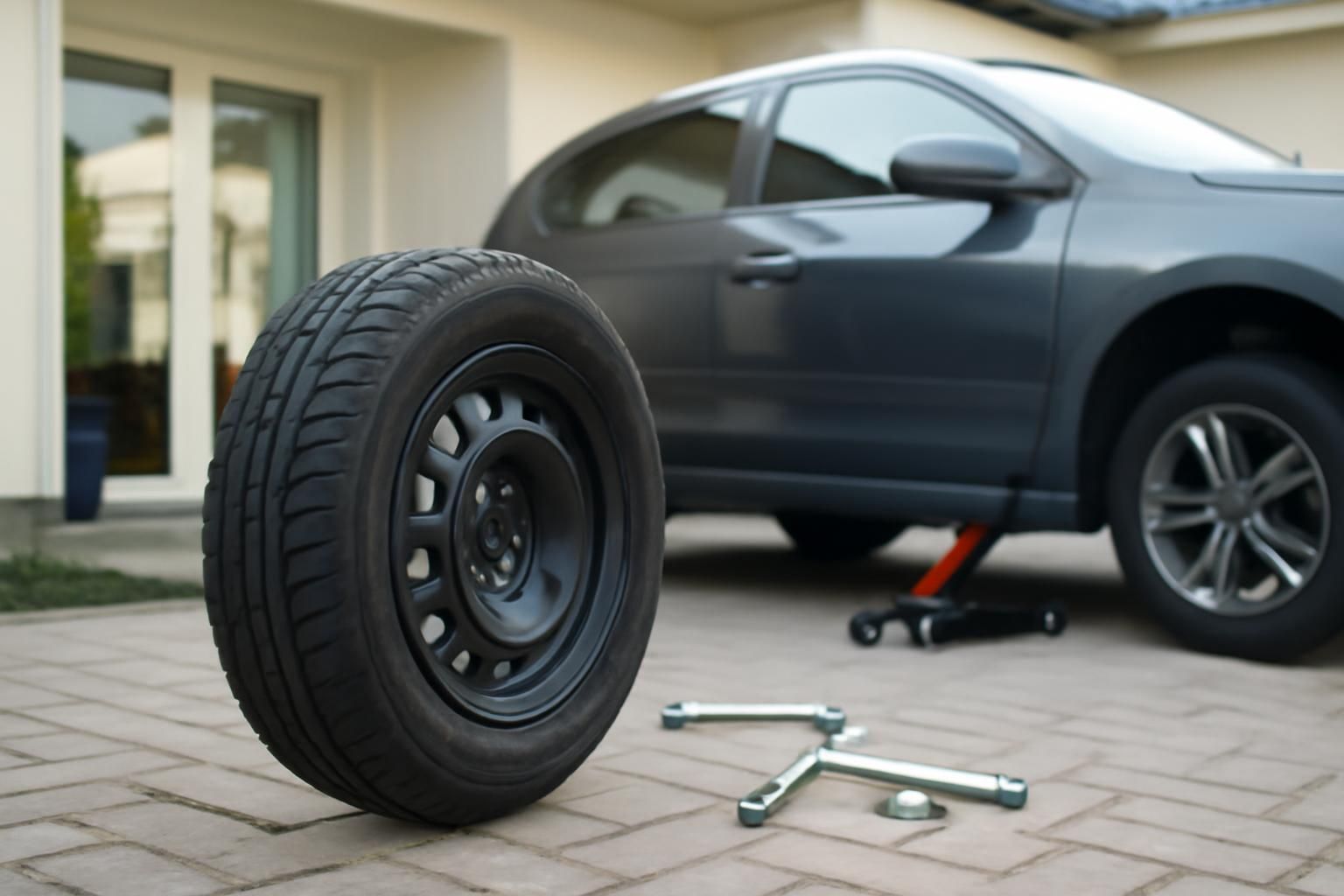
Consult the vehicle handbook to find the correct jacking point nearest the flat tyre. Place the jack on firm ground and ensure it sits vertically under the reinforced point. Never jack on the sill, plastic trim or a sloped or soft surface. Raise the car until the flat tyre is just clear of the ground.
- 5
Remove the flat wheel and fit the spare
Fully unscrew and remove the loosened wheel nuts, then pull the flat wheel straight towards you and off the hub. Lift the spare wheel onto the hub, align the bolt holes and push it flush. Thread the wheel nuts on by hand to avoid cross-threading.
- 6
Tighten the wheel nuts in a star pattern
Tighten the nuts finger-tight in a star or cross pattern so the wheel seats evenly against the hub. This prevents wobbling. Do not fully tighten with the brace yet, because the wheel may still shift if the car moves on the jack.
- 7
Lower the car, final-torque the nuts and check spare pressure
Lower the jack slowly until the tyre just touches the ground and the car's weight holds the wheel steady. Now tighten the nuts fully with the wheel brace in the same star pattern. Lower the car completely, remove the jack and stow the flat wheel. Check the spare tyre pressure as soon as possible. If you have a space-saver spare, remember the speed limit is typically 50 mph and it is for temporary use only.
Never change a tyre where you cannot get safely clear of traffic. On a motorway hard shoulder, get everyone out, behind the barrier, and call for assistance rather than changing it yourself. Never put any part of your body under a car supported only by a jack, and only jack at the manufacturer's designated point on firm, level ground. A space-saver spare is temporary and speed-limited, typically 50 mph. Drive gently and replace it with a full tyre as soon as possible.
Common mistakes
- Jacking the car before loosening the wheel nuts, which makes the wheel spin and the nuts nearly impossible to undo.
- Placing the jack on soft ground, a slope or the wrong point on the sill, which can let the car slip or damage the bodywork.
- Tightening the wheel nuts in a circle instead of a star pattern, causing the wheel to seat unevenly and wobble at speed.
- Forgetting to apply the handbrake or chock the wheels, allowing the car to roll while it is lifted.
- Driving on a space-saver spare without checking its pressure or ignoring the speed and distance limits.
Frequently asked
Do I loosen the wheel nuts before or after jacking?
Always loosen them slightly before jacking. The car's weight holds the wheel still, making the nuts much easier to turn. Once the wheel is in the air, it spins and you lose leverage.
How fast and far can I drive on a space-saver spare?
Typically no more than 50 mph, and only for a limited distance, often up to fifty miles. Check your vehicle handbook for exact limits. Replace it with a full-size tyre as soon as you can.
What if my car has no spare, only a tyre repair kit?
Follow the kit instructions exactly. Usually you inject sealant through the valve and inflate with the provided compressor. This is a temporary repair. Drive slowly to a tyre fitter and tell them the sealant has been used, as it may require special cleaning.
How tight should the wheel nuts be without a torque wrench?
Tighten them firmly with the wheel brace in a star pattern until you feel strong resistance. If you have a torque wrench, most cars need roughly 80 to 120 Newton-metres. Recheck the tightness after driving a short distance.
Is it safe to change a tyre on the hard shoulder of a motorway?
It is generally safer to call for roadside assistance on a motorway hard shoulder because traffic passes at high speed. If you must change the tyre yourself, get all passengers out and behind the barrier, never stand between the car and the traffic, and work facing oncoming traffic.
How do I know where the correct jacking point is?
The correct jacking point is shown in your vehicle handbook and often marked by a notch or reinforced area on the sill. Using any other point can damage the car or let the jack slip.