Quick answer
Turn the heating off, let radiators cool, open the bleed valve with a key until water appears, then close it and check boiler pressure.
Release trapped air from a radiator so it heats fully and the system runs efficiently.
What you’ll need
- Basic DIY
Step by step
- 1
Spot the symptom
Feel the radiator when the heating has been on. If it is warm at the bottom but cold at the top, trapped air is blocking the flow and the radiator needs bleeding.
- 2
Turn heating off and let cool
Switch the heating off at the timer or thermostat and wait until all radiators are cold. Bleeding a hot system is dangerous because pressurised water can scald you.
- 3
Position cloth and tray
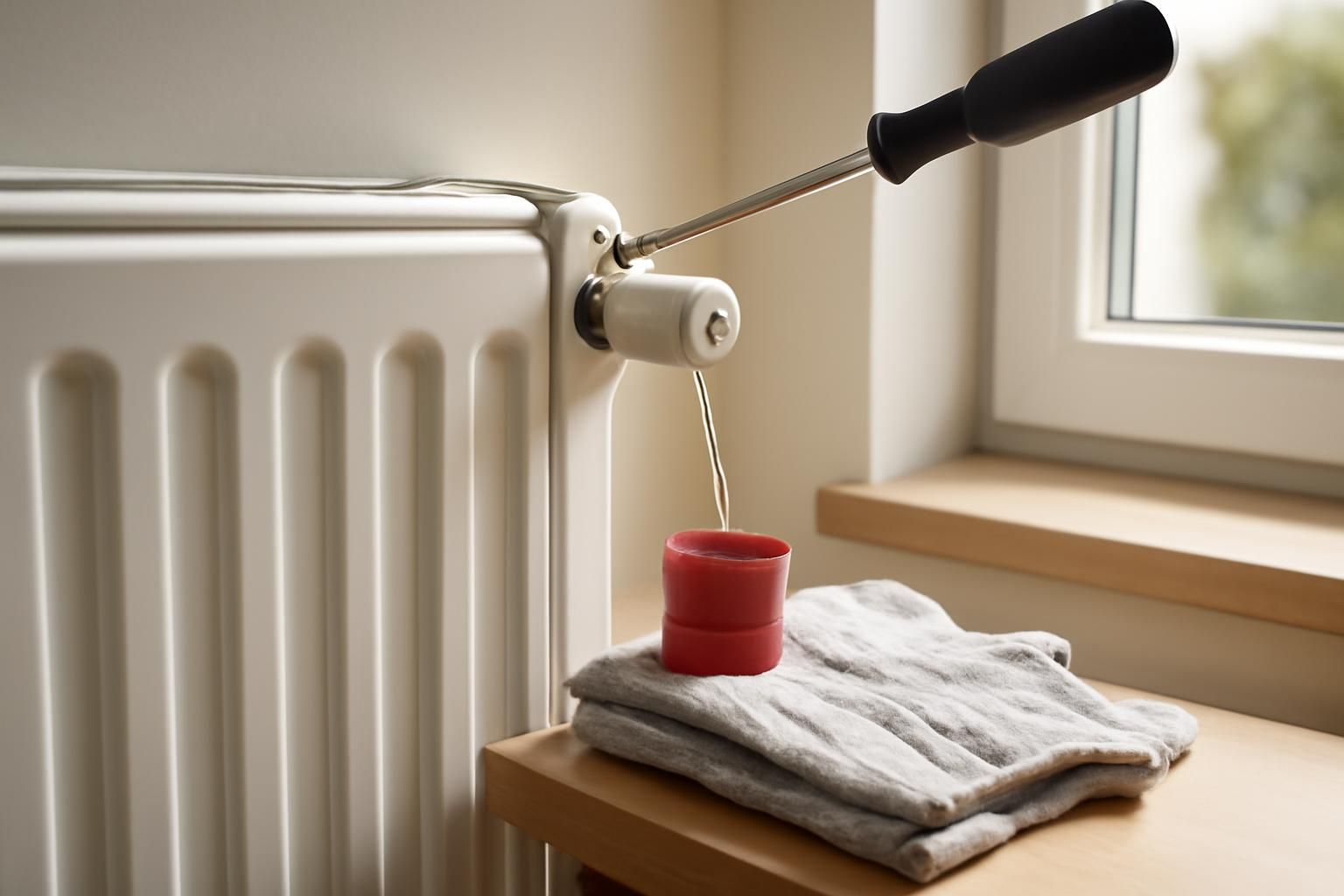
Lay an old towel or cloth under the bleed valve and place a small tray or cup beneath it. The water that escapes can be dark and will stain carpets or floors.
- 4
Open the bleed valve a quarter turn
Insert the radiator bleed key into the valve at the top of the radiator. Turn it slowly a quarter to half a turn anticlockwise. You should hear a hiss as air escapes.
- 5
Wait for hiss then water
Keep the key in place and let the air hiss out. Hold the cloth close to catch drips. As soon as a steady trickle of water appears, the air has gone.
- 6
Close the valve
Turn the bleed key clockwise to close the valve firmly but do not overtighten. Wipe away any spilled water with the cloth.
- 7
Recheck and top up boiler pressure
Switch the heating back on and check the boiler pressure gauge. Bleeding lowers pressure. If it is below 1 bar, top it up slowly using the filling loop until it reads roughly 1–1.5 bar. Do not work inside the boiler casing.
Common mistakes
- Bleeding while the heating is on and hot, which risks scalding spray and draws in more air.
- Opening the valve too far so water gushes out uncontrollably instead of a gentle trickle.
- Forgetting to recheck boiler pressure afterwards, leaving the boiler to cut out on low pressure.
Frequently asked
How do I know if a radiator needs bleeding?
Run the heating for half an hour, then feel the radiator. Cold at the top and warm at the bottom means trapped air. Gurgling or bubbling noises also suggest air in the system.
Which radiators do I bleed first in the house?
Start downstairs and work upwards, or follow the order recommended in your boiler manual. This follows the natural flow of the system and helps release air efficiently.
My boiler pressure dropped after bleeding — what do I do?
This is normal. Use the external filling loop to add water until the pressure gauge reads about 1–1.5 bar. Stop as soon as you reach the green zone. If pressure keeps dropping, there may be a leak — call a heating engineer.
What if no air comes out, or only water?
If only water comes out immediately, the radiator may not have much air in it. If no air or water comes out, the valve may be blocked or the pin is stuck. Do not force it.
How often should I bleed my radiators?
Check them at the start of the heating season and bleed any that feel cold at the top. Well-maintained systems usually only need bleeding once or twice a year.