Quick answer
Wrap a BSI-approved 80 mm cylinder jacket around your hot water tank. Secure it with the straps provided, leaving the thermostat pocket, immersion heater, and pressure-relief valve completely exposed. The job takes about 30 minutes and can pay for itself within weeks on an uninsulated tank.
If your hot water tank is uninsulated, you are losing heat and money every day. A correctly fitted 80 mm cylinder jacket costs around £15–£20 and can save roughly £35–£45 per year on a typical tank. The jacket pays back within weeks. Pre-insulated foam-clad tanks do not need an extra jacket. Check your tank first: if it already has a thick bonded foam coating, leave it alone.
What you’ll need
- tape measure
- BSI-approved 80 mm cylinder jacket (usually 1.2 m × 0.45 m or 1.5 m × 0.45 m)
- scissors (optional)
Step by step
- 1
Measure the tank
Measure the height from the base to the top, and the circumference around the widest point. Write both numbers down.
- 2
Buy the right jacket
Choose a BSI-approved jacket at least 80 mm thick. Thinner jackets save very little and are not worth fitting. Match the size to your measurements.
- 3
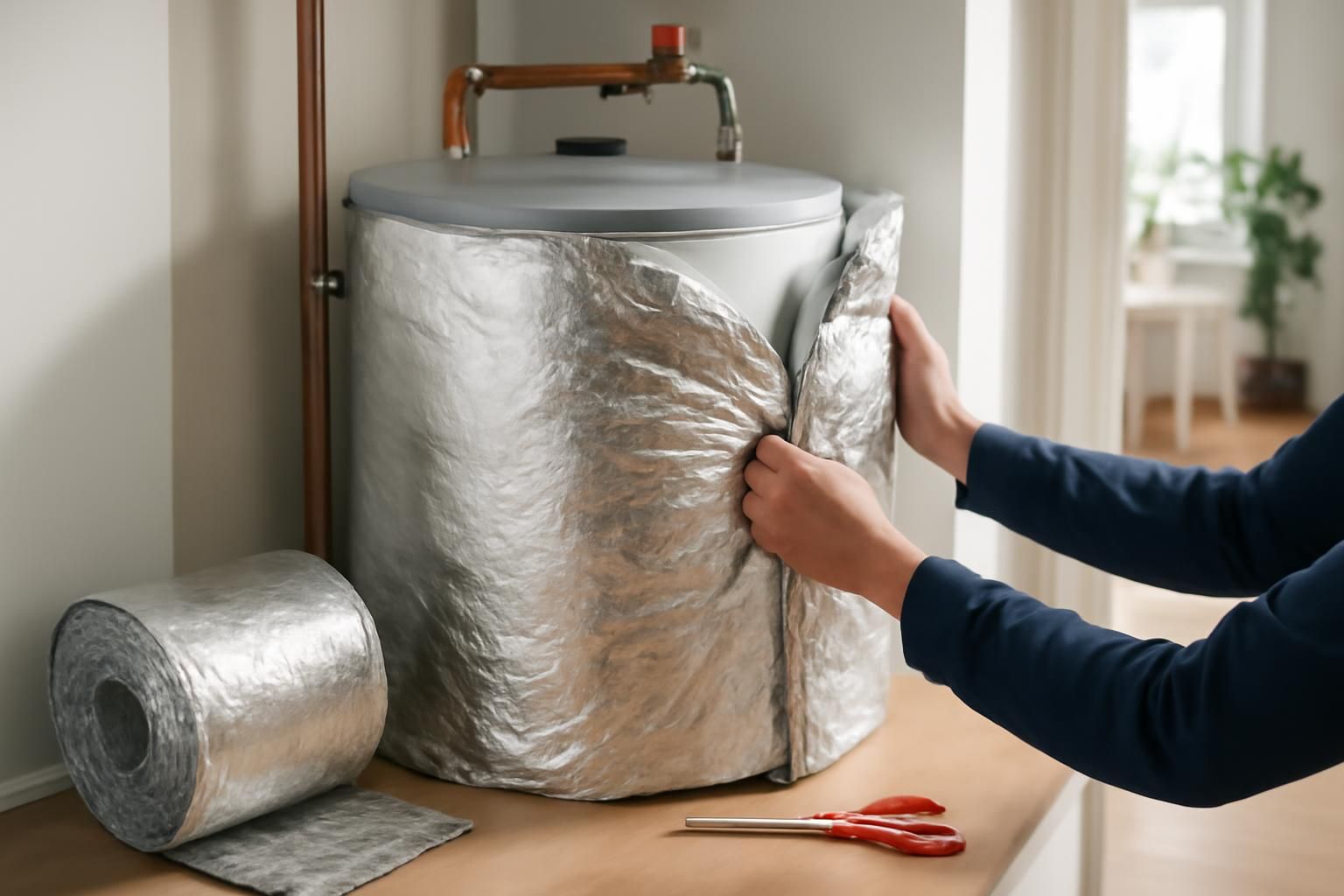
Wrap the jacket around the tank
Stand the jacket upright and wrap it around the cylinder so the insulation side faces inward. Overlap the ends by 50–100 mm.
- 4
Secure the straps
Fasten the straps at the top and bottom of the jacket. Pull them snug, but do not compress the insulation so hard that it thins out.
- 5
Leave access points clear
Cut or fold the jacket away from the thermostat pocket, the immersion heater boss, and the pressure-relief valve pipe. These must stay fully visible and reachable.
- 6
Check for gaps
Make sure there are no large gaps at the top or bottom. Cold bridging through gaps will wipe out most of the savings.
Do not cover the pressure-relief valve, thermostat pocket, or immersion heater with insulation. Blocking the pressure-relief valve is a safety hazard: if the tank overheats, the valve must discharge freely. Trapping heat around the thermostat can also give false temperature readings and make the water dangerously hot.
Common mistakes
- Buying a jacket thinner than 80 mm — it offers minimal savings and is not worth the effort.
- Covering the thermostat stat pocket or immersion heater boss with jacket material — this blocks access and can trap heat at the sensor, giving false readings.
- Leaving large gaps at the top or bottom of the jacket — cold bridging undermines most of the insulating benefit.
Frequently asked
Does insulating the tank affect the water temperature or pressure?
No. Insulation only slows heat loss. It does not change the pressure or the thermostat setting. The water will stay hot for longer after the heating turns off, but the maximum temperature stays the same.
Can I use a tank jacket on a combination boiler system?
No. Combination boilers heat water on demand and do not store hot water in a cylinder. If you have a combi boiler, there is no tank to insulate.
Where can I buy an approved hot-water cylinder jacket and what should it cost?
Most DIY shops and hardware stores stock BSI-approved cylinder jackets. Expect to pay £15–£20 for a standard size. Check the label for the BSI mark and confirm the thickness is at least 80 mm.