Quick answer
Place the level on the surface and look straight at the vial. If the bubble sits between the two lines, the surface is level. Note which side the bubble favours — that side is higher. Flip the level end for end to check the tool is accurate. For long runs, use the longest level you have.
A spirit level is the fastest way to check that a shelf, picture rail, or fixing is flat and straight. Most levels have two vials: one for horizontal and one for vertical. Some have a third for 45 degrees. The trick is reading the bubble correctly and checking that the level itself is true.
What you’ll need
- Spirit level (30 cm or longer)
- Tape measure
- Pencil
- Straightedge (optional)
Step by step
- 1
Understand the vials
The horizontal vial checks level; the vertical vial checks plumb. A third vial, if present, checks 45 degrees. The bubble shows which end is high: if it sits to the left, the left end is higher. If it sits between the two lines, the surface is level.
- 2
Clean the contact surface
Dust, textured paint, or proud screw heads will lift the level and give a false reading. Wipe the surface and ensure the level's edge sits flush along its entire length.
- 3
Read the bubble straight on
Look directly at the vial from above or in front. Reading from an angle causes parallax error, where the bubble seems centred when it is not. Crouch or step back so your eye is level with the vial.
- 4
Mark and extend
Hold the level against the wall. Mark the surface at each end of the level with a pencil. Move the level along, align one end with the previous mark, and mark the new far end. Join the marks with a straightedge. This is faster and more accurate than rechecking every measurement.
- 5
Check calibration with the reverse test
Place the level on a flat surface and note the bubble position. Flip the level end for end and place it in the same spot. If the bubble reads differently, the vial is out of true and the level is misleading you. Drop-tested levels often fail this check.
- 6
Work to length
A 30 cm level can hide error across a 1.5 m span. Use the longest level practical for the job. For very long runs, set a taut string line and measure down to it at intervals, or use a laser level.
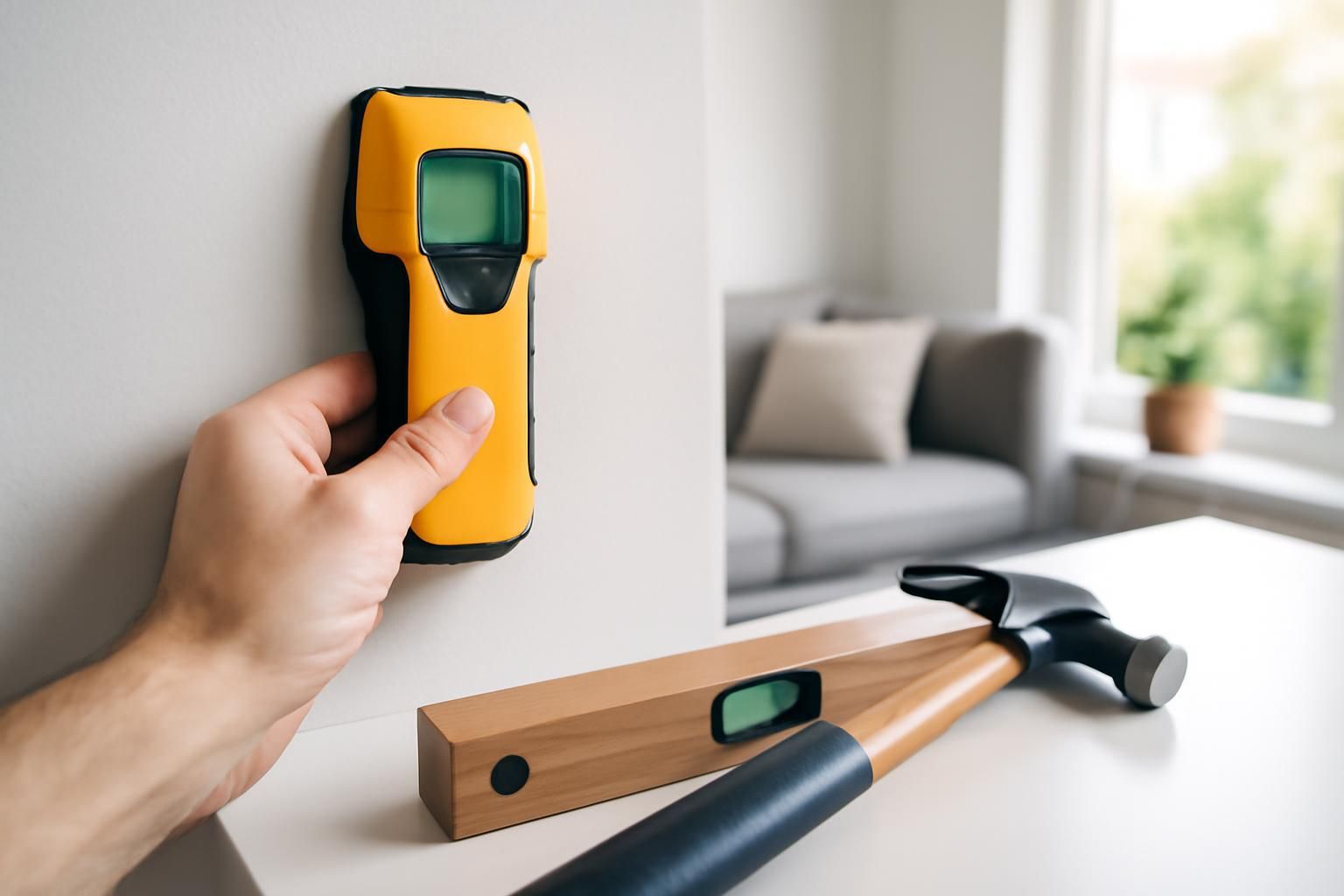
The biggest hazard is trusting a damaged or inaccurate level and drilling multiple holes that are all slightly off, especially when hanging heavy or load-bearing items. Always perform the reverse test after a drop. If you are fixing anything heavy or overhead and cannot locate solid masonry or a stud, call a professional. For heavy items, the bracket must be rated for the loaded weight and secured into solid masonry or a stud. If you are unsure what is inside the wall, use a stud finder first.
Common mistakes
- Resting the level on an uneven surface such as textured paint or proud screw heads. This lifts the level and gives a false reading.
- Reading the bubble from an angle. Parallax error causes a false reading; always look straight on.
- Using a short level for a long run. A 30 cm level can hide cumulative error across 1.5 m.
Frequently asked
Does a cheap spirit level give reliable results, or should I buy a better one?
A cheap level with fixed vials can be accurate if it passes the reverse test. Spend a little more for machined edges and shock-resistant vials if you use it regularly. For occasional jobs, a basic 60 cm level is fine.
How do I check if my spirit level is still accurate after it's been dropped?
Use the reverse test. Place it on a flat surface, note the bubble position, flip it end for end, and compare. If the reading changes, the vial has shifted and the level is no longer reliable.
Can I use a spirit level app on my phone instead?
Phone level apps are convenient for rough checks but depend on your phone's accelerometer, which can drift. They are not precise enough for critical fixings or long spans. Use a real level for anything you will drill into a wall.